
Finding Residents Across Tucson Records
A useful Tucson residents directory search begins with the record that best fits the clue. A name can enter through the Pima County Assessor, a court party index, a corporation filing, or a historical directory. An address works better in the parcel roll, PimaMaps, the deed index, and Tucson Property Research Online. An older name belongs in city directories, census schedules, newspapers, probate files, and archival vital records. No one source proves current residence. The Assessor identifies a title holder, not every person in a home, while an old directory records only what a publisher gathered for that edition.
Use two independent anchors before accepting a match. A middle initial, spouse, parcel description, business affiliation, age range, or repeated address can separate people with the same name. Tucson names may also appear with Spanish compound surnames, reversed surname order, omitted accents, initials, or a spouse's name. Copy the spelling used by each index. Do not silently correct it.
- Search the Pima County Assessor by owner name or address and copy the parcel number, situs address, mailing address, and vesting name.
- Open PimaMaps to confirm jurisdiction, parcel shape, nearby lots, plats, permits, and the legal geography behind the address.
- Follow the parcel or party name into the Recorder's index, then verify a deed by legal description and recording date.
- Check the right court, archival, license, or directory source for a second identity anchor.
- Use the clerk counter, recorder terminal, library shelf, archive, or a narrow Title 39 request when the web trail ends.
Renters, relatives, lodgers, and unlisted residents often leave no property entry. A gap is a limit of the source, not proof that nobody lived there.
Offices Behind Tucson Resident Records
Pima County, not one city department, keeps most Tucson resident records. The Assessor is the first stop for current parcel ownership. The Recorder preserves deeds, liens, plats, and other recorded instruments. The Clerk of the Superior Court controls civil, criminal, family, probate, marriage, and divorce court files. Tucson City Clerk routes municipal requests, while Arizona agencies maintain voter self-service, vital records, licenses, and archival collections. Postal Tucson extends beyond city limits, so check jurisdiction before sending a city request.
Pima County Recorder
240 N. Stone Avenue
Tucson, AZ
Weekdays, 8 a.m. to 5 p.m.
Public Records Research
Pima County Assessor
Current parcel roll
Owner, address, value, and parcel details
Free online search
Assessor Parcel Search
The eastside Recorder office at 6920 E. Broadway Boulevard, Suite D, offers limited services from 8 a.m. to 4:30 p.m. and closes from noon to 1 p.m. Older unindexed images can be viewed on public computers at either Recorder location.
Start Tucson Lookup With a Parcel
The Pima County Assessor Parcel Search accepts a parcel, address, or owner name in its main box. Advanced routes include property owner, property address, map and plat, recorded document number, Public Land Survey System fields, and subdivision name. A result can show vesting, the owner mailing address, situs address, parcel ID, tax area, legal description, values, building facts, acreage, sketches, maps, and links to tax and recorded-document sources.

The combined entry box makes the roll useful whether the known clue is a person or a place. Still, title ownership is not the same as occupancy. A mailing address that differs from the situs may suggest that the owner receives tax mail elsewhere, but it does not identify who occupies the Tucson parcel.
| Search route | Best clue | Useful result |
|---|---|---|
| Owner name | Surname or entity | Matching parcels and vesting |
| Property address | Situs address | Parcel card and legal description |
| Recorded document | Sequence number | Parcel tied to an instrument |
| Subdivision | Development name | Parcels within the plat |
Map Tucson Residents by Jurisdiction
A Tucson mailing address may sit in the city, South Tucson, or unincorporated Pima County. PimaMaps resolves that geography. Search an owner, address, intersection, or parcel without punctuation, select the result, and use the parcel popup's More Information links. Layers can add zoning, floodplains, permits, plats, fire districts, aerial images, wastewater, and topography. Identify and Measure tools inspect nearby features, while a query can be saved and exported to XLSX.
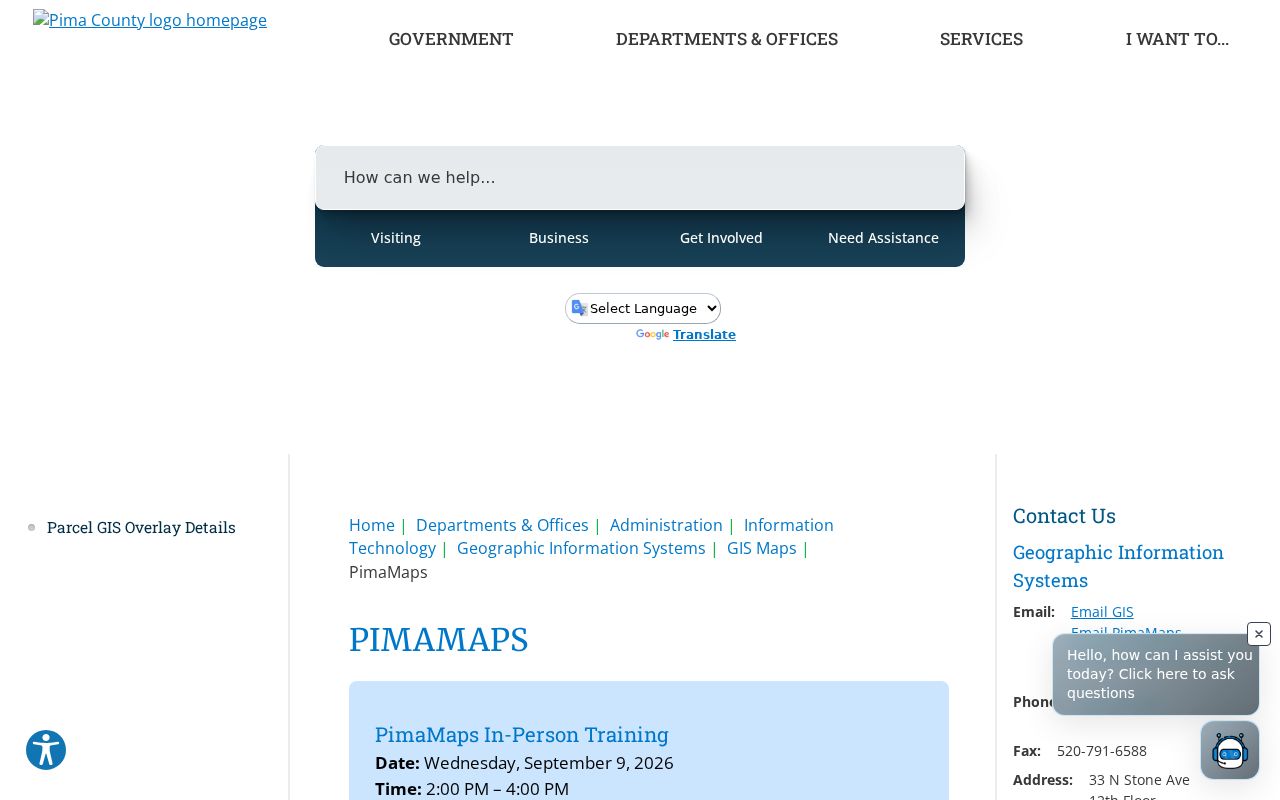
The map connects a street clue to the correct records office. GIS lines are illustrative and are not a boundary survey, but parcel IDs and jurisdiction fields prevent a request from going to the wrong custodian. A full parcel-by-parcel method belongs in the Tucson street directory.
- Parcel
- A tax unit identified by the Assessor, which may change after a split or combination.
- Situs address
- The physical location of the land, distinct from the owner's mailing address.
- Plat
- A recorded map showing lots, blocks, streets, and subdivision layout.
- Index
- A finding aid that points to a document; it is not the certified document itself.
Tucson Deeds Cross the 1982 Line
The Pima County Recorder Public Search is a strong Tucson residents directory source for named parties to deeds, liens, releases, plats, affidavits, and other instruments. Documents from June 1982 forward are fully indexed. Historical material reaches toward the county's 1865 beginnings, but much of the earlier span still requires office terminals and unindexed images. In December 2021, the Recorder made every indexed image available online as a free low-resolution watermarked view.
Search by a person's name, sequence number, docket and page, recording date range, or document type. To trace ownership, start with the current vesting from the Assessor, find that owner's acquisition deed as grantee, copy the seller's name, then search the seller as a prior grantee. Confirm each step through the legal description rather than a street number alone.
| Recorder field | Use in a resident search | Limit |
|---|---|---|
| Name | Find grantors, grantees, and indexed parties | Common names need dates and property details |
| Sequence number | Open a known recorded instrument | Requires an existing reference |
| Docket and page | Retrieve a legacy book citation | Not every old image is name-indexed |
| Recording date | Narrow a transfer window | Date does not prove occupancy |
Free watermarked images help with research. Clean copies suitable for official use are paid, and a certified copy must come from the custodian.
Current Tucson Directory Sources
Current Tucson resident evidence is split by purpose. Official sources record ownership, filings, court parties, permits, licenses, and a voter's own registration, but none is a complete household list. Start with the narrowest source and note what its entry actually proves. A property card proves the listed vesting at the time of the roll. A court index proves that a name appears in a participating case. A professional record connects a person to a credential, not necessarily to a home.
| Source | Who It Lists | Keeper | Access |
|---|---|---|---|
| Parcel roll | Title owners and mailing destinations | Pima County Assessor | Free portal |
| Recorded documents | Parties to deeds, liens, plats, and releases | Pima County Recorder | Free index and watermarked images |
| Voter self-lookup | The authenticated voter's own registration and districts | Arizona and Pima Recorder | Identity-verified; bulk use restricted |
| Court indexes | Public parties, case types, dates, and events | City, county, state, and federal courts | Index free; some documents paid |
| Permit and code files | Address activity, dates, types, and public documents | City of Tucson | PRO plus request fallback |
Commercial people-finder products combine public and purchased data. Their results may lag corrections or merge same-name people, so treat the category as a clue rather than proof. Official custodians are slower and narrower, yet each record has a known origin and correction path.
Lawful use. Tucson records are for lawful research and civic access. Never use a name, address, or record to stalk, harass, threaten, or defeat a protected-address program.
Choose the Right Tucson Court
Tucson court records are divided by jurisdiction. City Court handles city misdemeanors, traffic, and ordinance matters. Pima Consolidated Justice Court covers limited-jurisdiction cases, while Pima County Superior Court keeps felony, larger civil, family, and probate matters. Arizona Public Access searches 177 of 184 courts, but Pima Justice and Superior Court are only partly represented. A missing statewide hit should lead to the local clerk, not a conclusion that no file exists.
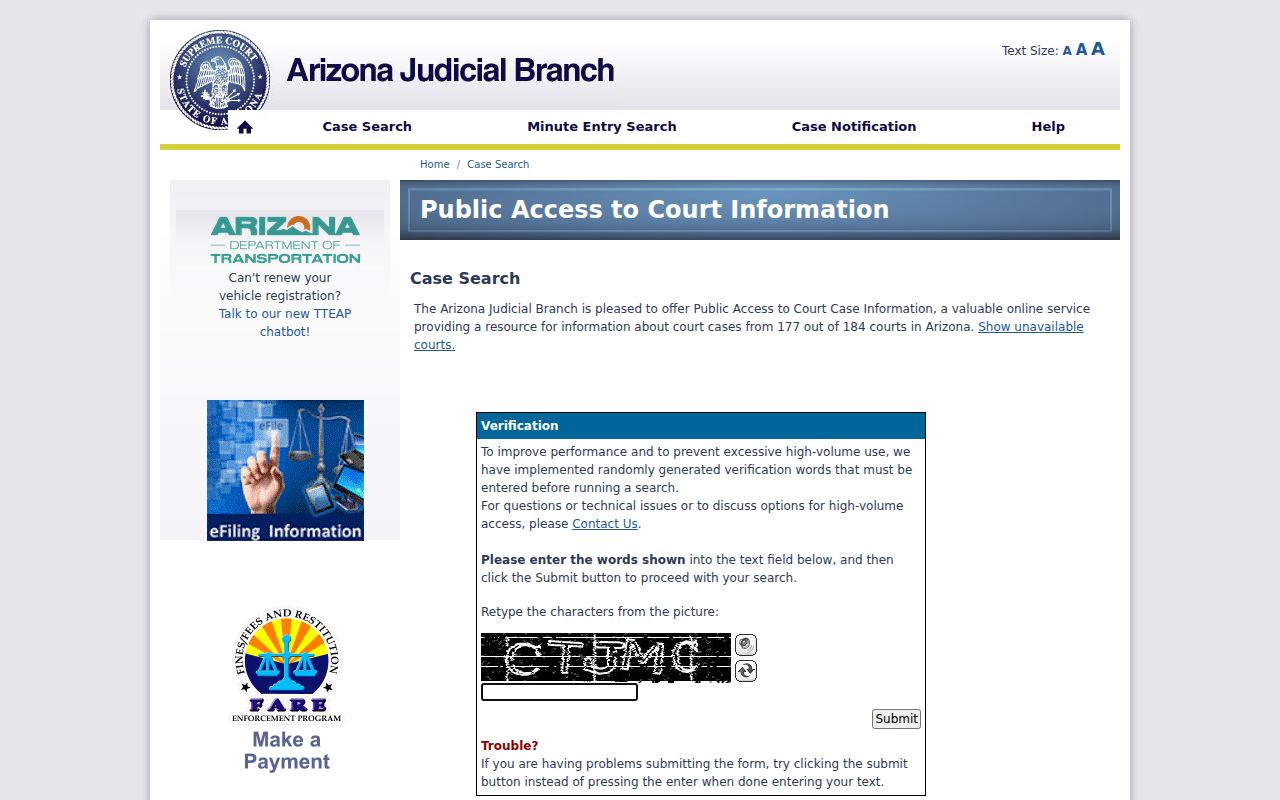
The statewide form uses a CAPTCHA, case number or party name, optional middle name, court or county, and case category. Results can show a case number, court, filing date, party roles, events, status, hearing dates, and judicial assignment. Sealed cases, protection orders, mental-health matters, victim data, many juvenile cases, and probate are excluded. Public Access is an index, not the official court file.
eAccess provides paid Superior Court documents for covered cases, generally from July 2010, with Pima criminal documents beginning in July 2015. Older cases, probate, and official copies route to the Legal Records Department.
Arizona Voter Lookup Stays Personal
The Arizona Voter Information Portal is an authenticated self-lookup, not an open Tucson residents directory by surname or block. A voter selects Pima County and supplies a registered last name, date of birth, and an identifying number when requested. The result can confirm registration status, election districts, notices, ballot-by-mail status, and voting history. Participation history means that a ballot was cast in an election. It never reveals how the voter marked it.
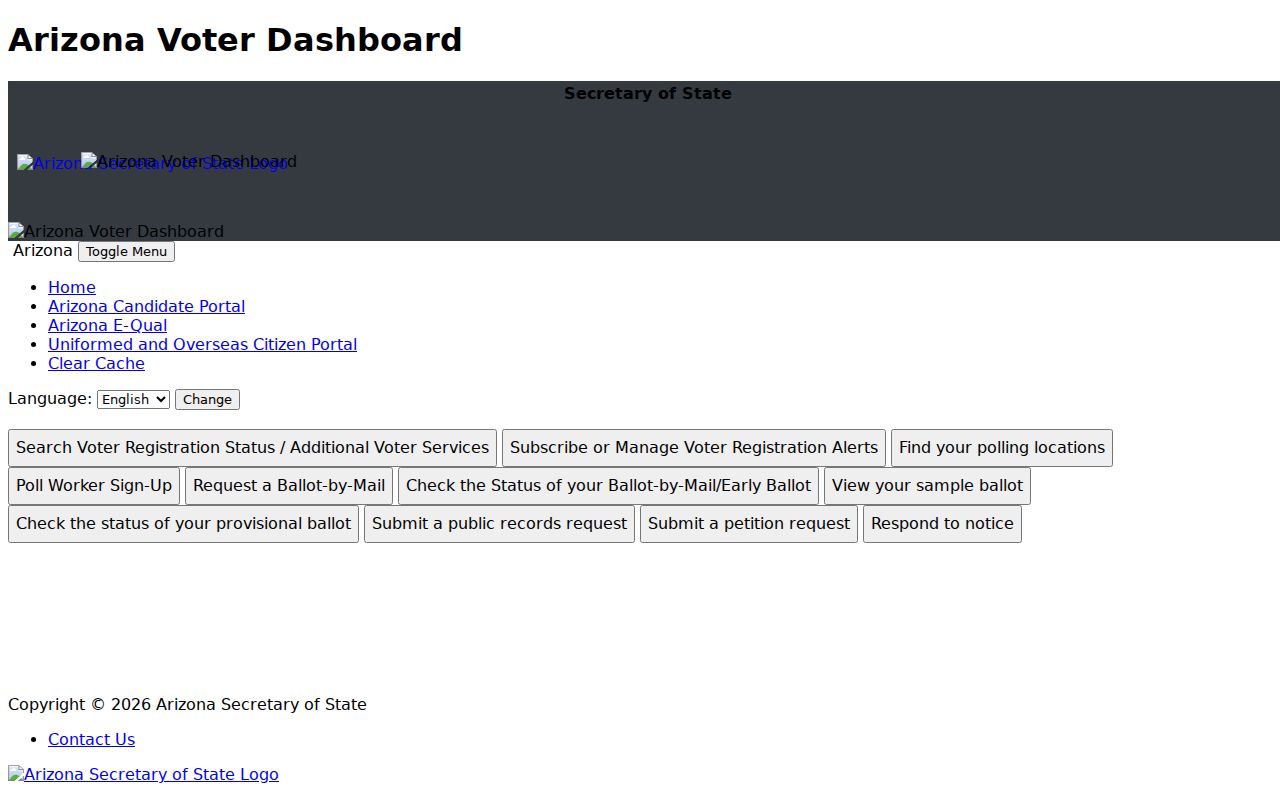
Arizona law limits registration-derived bulk data under A.R.S. §16-168(E). Pima County requires an authorized statutory purpose, a signed request, and supporting campaign or committee details where applicable. Protected identifiers and addresses remain shielded. The state's Address Confidentiality Program also supplies qualifying survivors with a substitute address and mail forwarding. Do not try to rebuild a protected location from other rolls.
Tucson Vital Records Split by Age
Current Arizona birth and death certificates are restricted records, not general resident listings. Pima County issues Arizona births from 1950 and certificates for deaths that occurred in Pima County. Eligible applicants must document identity and relationship or legal interest. The Arizona Bureau of Vital Records handles statewide routes and events outside local coverage.
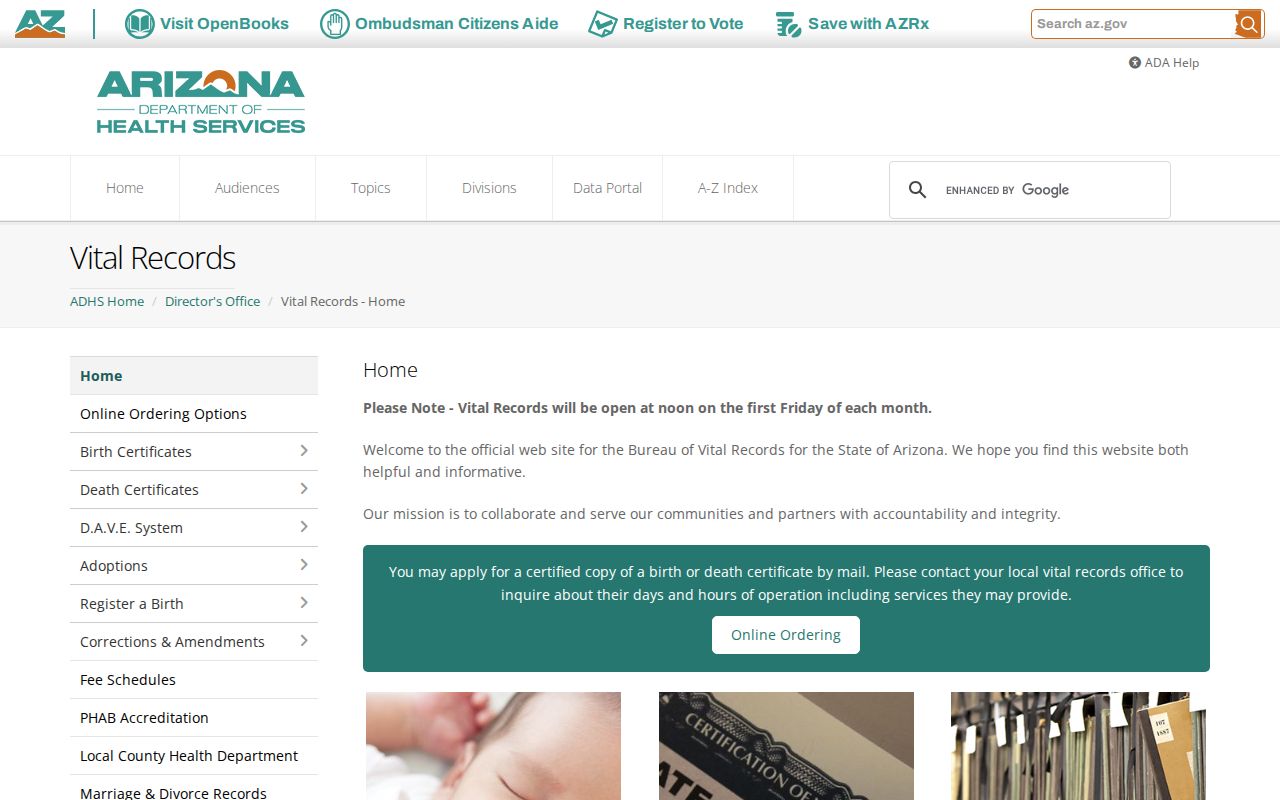
Archival rules create a different path. Under A.R.S. §36-351, births transfer for public access after 75 years and deaths after 50 years. The Arizona genealogy search can then supply names, dates, places, and certificate images. PCPL describes its current historical search span as births from 1800 through 1948 and deaths from 1800 through 1974, with the statutory window advancing over time.
Marriage licenses and divorce decrees are court records through the Pima Clerk. They are not substitutes for state birth or death certificates.
Tucson Permits Build Address Evidence
Tucson Property Research Online, known as PRO, searches by address, parcel, or activity number. An address result can identify City of Tucson jurisdiction and display permit or application numbers, status, application and completion dates, type, narrative descriptions, code-enforcement matters, and attached documents. Complainant names in code cases are redacted. A permit connects activity to a place; it does not establish every person who lived there.
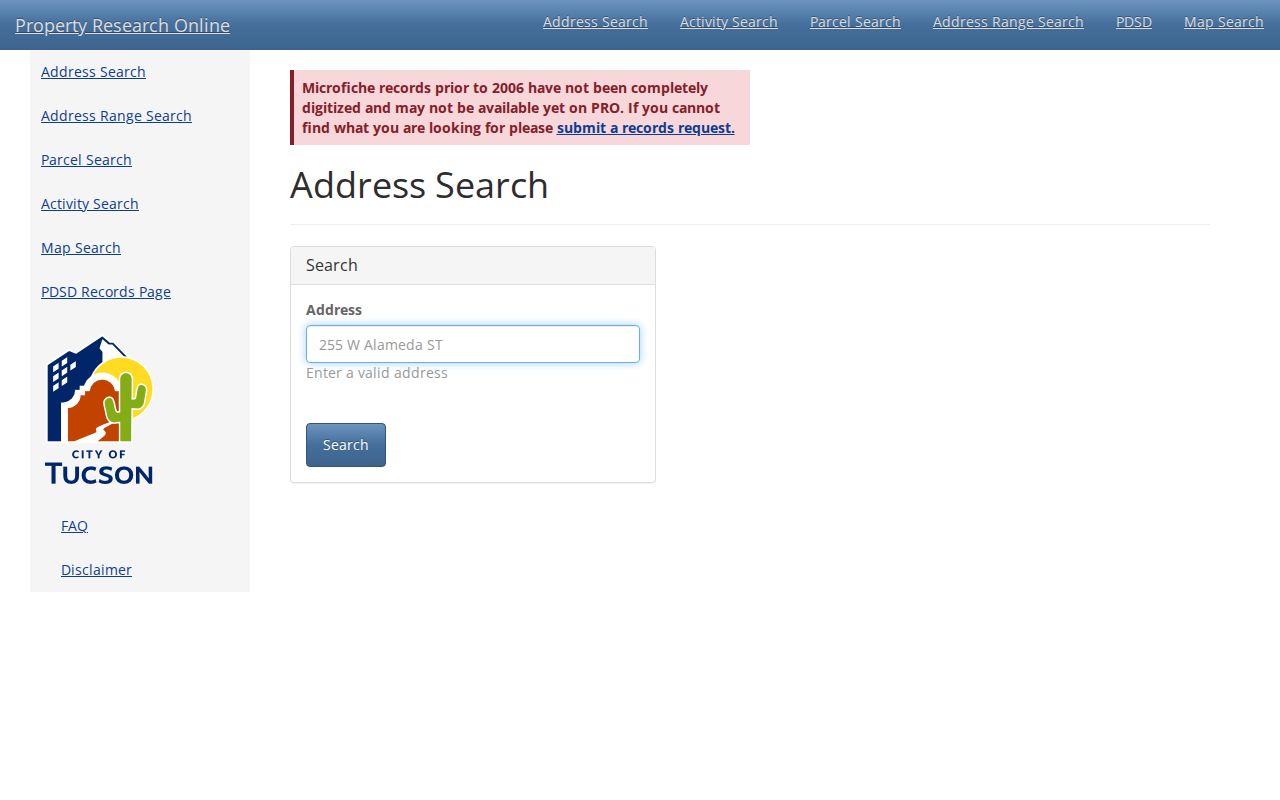
For missing historical permit records, Planning and Development Services directs users to check PRO first, confirm city jurisdiction, then choose “Request Historic Records” through a Tucson Development Center Online account. Enter individual addresses rather than parcel numbers and specify documents, plans, or both. The department reports a typical completion time of four weeks and keeps building-permit material only.
Request Tucson Records Under Title 39
Arizona Public Records Law begins with A.R.S. §39-121, which opens records in an officer's custody for inspection during office hours. Section 39-121.01 requires preservation and prompt furnishing, but Arizona sets no single production deadline for every request. Section 39-171 requires a published contact and, when no centralized portal gives a receipt, acknowledgement within five business days. Noncommercial inspection is ordinarily free. Authorized copy costs may apply.
The Tucson City Clerk public-records route asks for contact details, the responsible department, a precise description, and whether the requester wants inspection or copies. Ordinary paper copies are listed at $0.25 per page. Archived, cross-department, or redaction-heavy work can take longer.
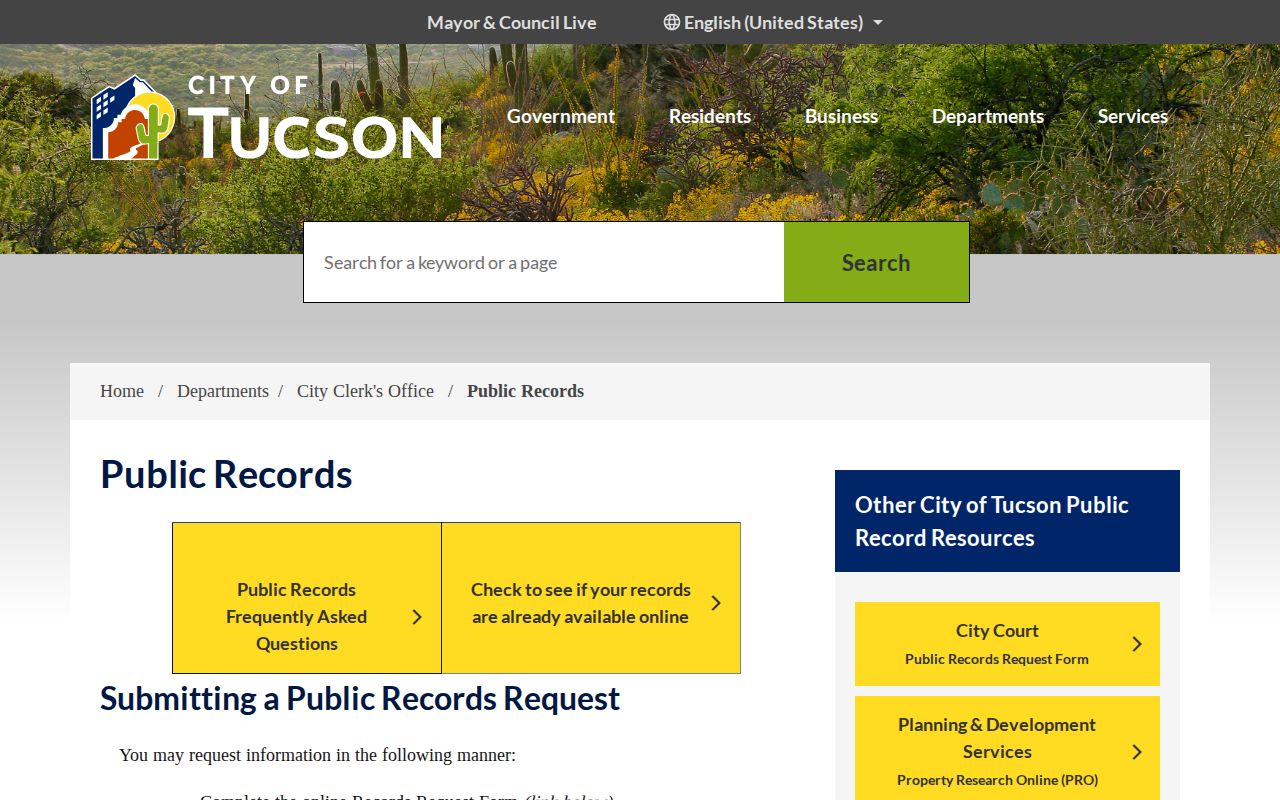
The city page points a Tucson request toward the department that created the record. Describe one address or person, a date range, the record type, and the likely office. A narrow request is easier to locate and redact than a demand for every record about a person.
When Tucson Online Records Stop
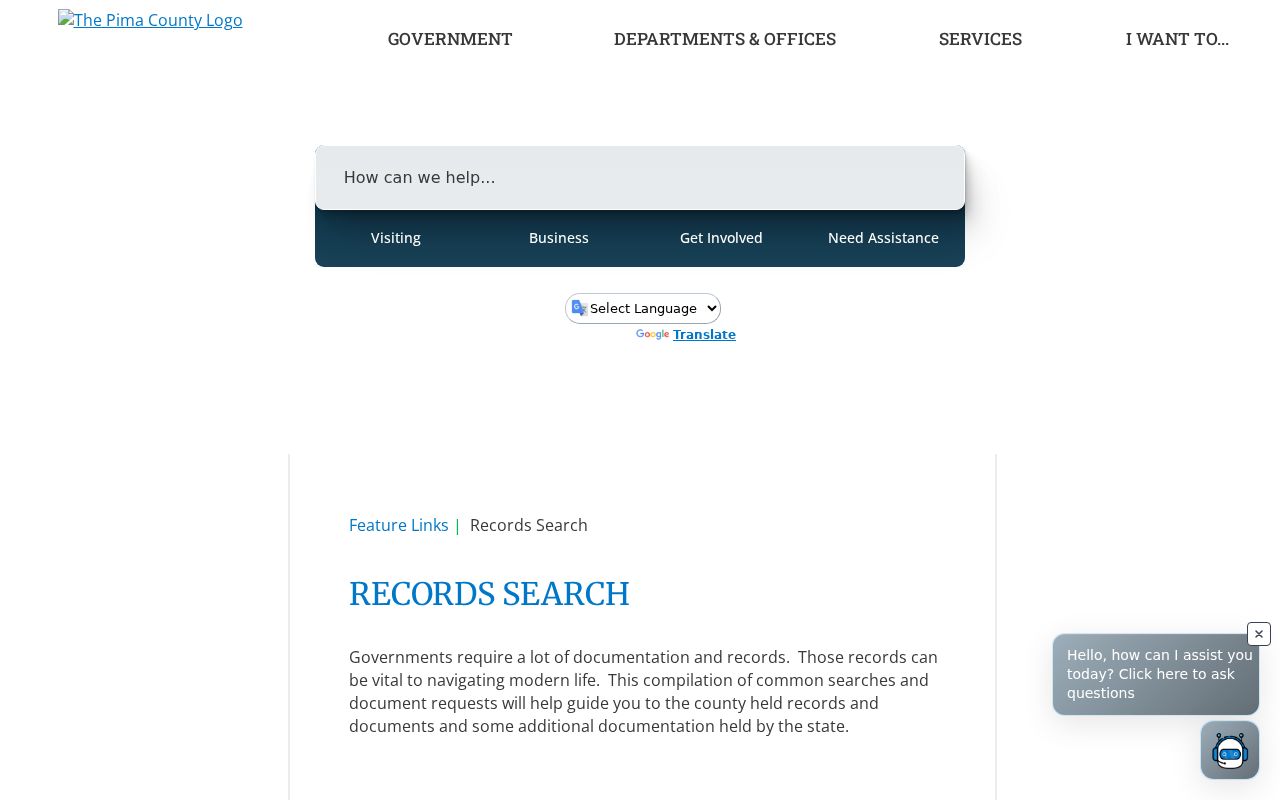
An incomplete web search often means the material is counter-only, unindexed, licensed, or on a library shelf. Pima County's records search guide routes common county, court, and vital requests. Recorder terminals reach pre-1982 images. The Clerk counter handles older and probate files. Joel D. Valdez Main Library, the Arizona Historical Society, and University of Arizona Special Collections hold directories, maps, papers, newspapers, and regional collections that never became one online index.
The fallback path matters most for genealogy, heirs, and old addresses. Call PCPL Infoline for up to three criss-cross address or telephone lookups, visit the third-floor Arizona Collection, search the archive catalog, or ask the correct custodian for a known file. “Not online” does not mean destroyed.
Historical Tucson Residents Directory Shelf
Tucson's first city directory was G.W. Barter's 1881 volume. Publication was intermittent at first and became nearly annual after 1899. Pima County Public Library reports that its holdings, the Arizona Historical Society, Ancestry, and the Arizona Memory Project together cover every published Tucson directory year through 2003. Arizona Memory Project currently filters 37 digitized Tucson directory objects, while print and microfilm runs remain at Joel D. Valdez Main Library and AHS Tucson.
An entry may show a resident's name, occupation, spouse, address, ownership mark, widow notation, or cross-reference. Later reverse, or criss-cross, sections turn an address into a listed occupant and nearby addresses. Gaps may reflect a year with no publication or a rented criss-cross volume returned to its publisher, so absence does not prove a move. The full shelf, entry keys, and between-census tracing method are detailed in the Tucson city directory collections.
Pair directories with the public census through 1950, deeds, Sanborn maps, newspapers, probate, and archival vital records. Together, those sources can follow a family or former classmate and explain a change that no single roll records.