
Tucson Resident Lookup Sources
No official source is a complete list of Tucson residents. The Pima County Assessor names title owners, not all occupants. Recorder documents connect parties to recorded property events. Courts identify parties in public cases, subject to large exclusions. Arizona's voter portal confirms the signed-in voter's own record rather than offering open name browsing. Historic vital certificates become public only after statutory archival periods. A useful Tucson resident lookup chooses the record that fits the known fact, then seeks a second independent match.
| Record | What It Confirms | Where to Search | Access |
|---|---|---|---|
| Assessor parcel | Title owner, situs, and chosen mailing address | Pima County Assessor | Free current roll |
| Recorded document | Named party, legal-property link, and transaction date | Pima County Recorder | June 1982 onward indexed; older records at office |
| Court case | Party, case type, dates, and public disposition | Local court search and Arizona Public Access | Free metadata; some document images paid |
| Historic vital record | Birth or death identity, date, place, and family facts | Arizona genealogy and archives | Births after 75 years; deaths after 50 years |
| Business or license | Public affiliation, status, and filing address | AZCC and state boards | Public metadata; filings vary |
| Directory or yearbook | Historic address, spouse, trade, or school-year link | PCPL, AHS, and UA collections | Library, archive, or licensed access |
Start with the strongest fact already known. An address points to the Assessor. A case number goes to the named court. A death before the public threshold belongs in the archive index, while a recent certificate requires eligibility. A business name starts with the Arizona Corporation Commission because Arizona corporations and LLCs are filed there, not with the Secretary of State. The result should narrow a person, never stretch a vague clue into a claim.
Checking Tucson Court Records
Tucson cases are divided among Tucson City Court, Pima County Consolidated Justice Court, Pima County Superior Court, Arizona appellate courts, and federal court. The statewide Arizona Public Access Case Lookup reports data from 177 of 184 courts, yet it warns that Pima Justice and Superior Court are only partly represented. Run the state name search, then follow the local court's record search and confirm the official file with its clerk.
Public Access first presents a CAPTCHA. Search fields can include case number, first, middle, and last name, date of birth where offered, court, county, and case category. Sealed cases, protective orders, mental-health matters, probate, victim and witness data, and several juvenile categories do not appear. Updates run on a weekly cycle, and displayed data is not the official record.
The Arizona Superior Court eAccess service is the separate channel for eligible document images.
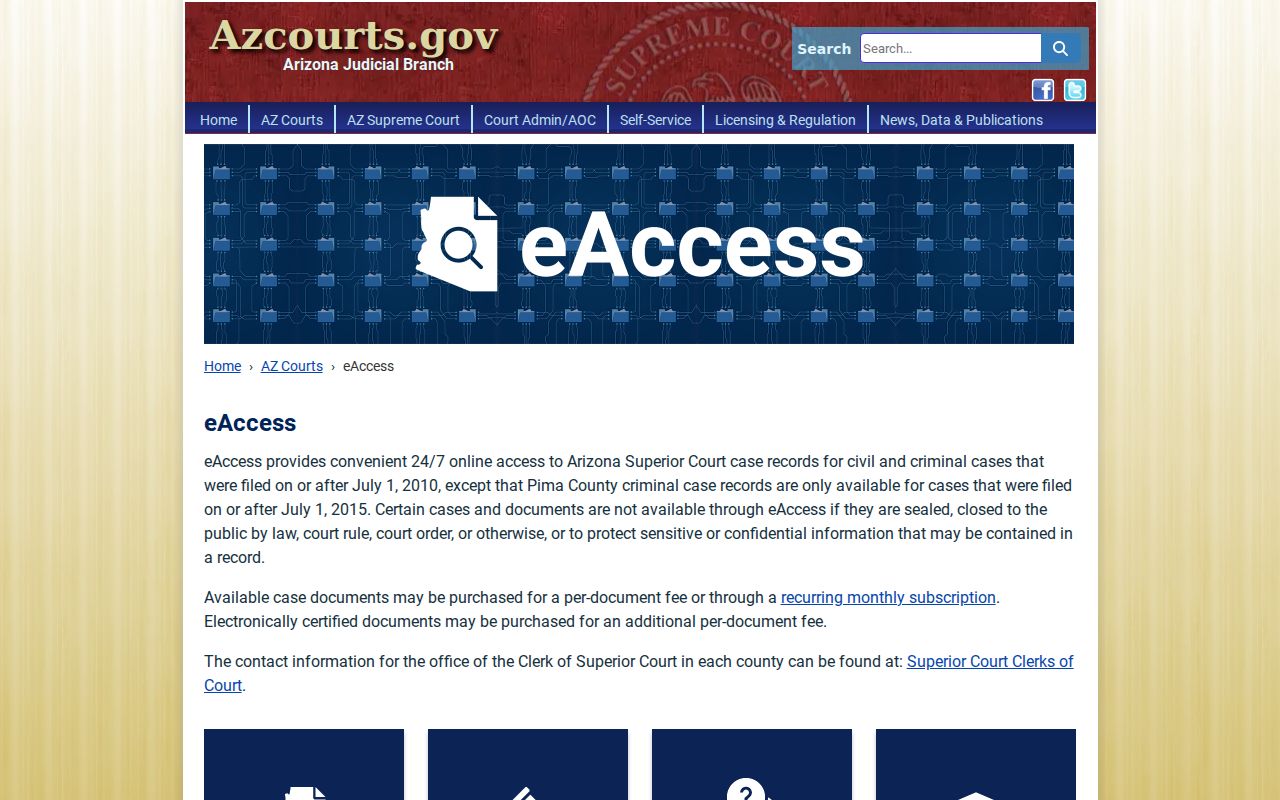
The eAccess screen reinforces the key distinction: statewide case metadata and paid Superior Court document access are related but separate systems.
Tucson Lookup Result Details
A court name hit is a lead, not identity proof. A public docket result may provide enough structure to rule a person in or out. Compare the court and filing date first. Then look at party roles, case type, events, public status, and counsel. If the record matters, request the official file from the clerk. The Pima Clerk Legal Records Department at 110 W. Congress Street can route requests for older files and material absent online, subject to sealing and redaction.
- Case number, court, filing date, and case category
- Public party names and roles
- Claims, charges, events, or docket descriptions
- Hearing dates and judicial assignment when public
- Disposition or current public status
eAccess generally covers Superior Court civil and criminal cases filed on or after July 1, 2010. Pima criminal document coverage begins July 1, 2015. Documents may carry per-item or subscription charges, and electronic certification costs extra. Probate is especially important for an heir search, but statewide Public Access excludes it. Use the local Pima Superior Court channel instead.
Verifying Tucson Resident Records
A same-name match becomes credible only when two independent anchors agree. Normalize initials, married and prior surnames, surname particles, and Spanish double surnames. Preserve the exact indexed form, including dropped accents or reversed surname order. A parcel legal description, spouse, middle initial, age range, business entity, or consistent address can serve as an anchor. One common-name docket entry cannot.
- Search the Pima Assessor by owner name when a property link is likely. Record the parcel, situs, vesting, and mailing address without assuming ownership proves occupancy.
- Check the Pima Recorder for a deed that links the same name to the parcel and date. Reverse grantor and grantee roles if tracing a transfer.
- Search the relevant local and statewide court indexes with middle name and category filters. Compare dates and roles, not just spelling.
- Use an open historical vital index, obituary, business filing, license number, or directory entry as a second independent anchor.
- Order a certified record only from the custodian when official proof is needed and access rules permit it.
This process can also expose a false match quickly. If a court age, parcel date, or spouse conflicts with the known person, stop. Do not merge the records. Telephone clerks may explain where a file is held and how to buy a copy, but they do not perform broad identity research or disclose sealed facts.
- Docket
- The dated list of filings, hearings, orders, and other events in a court case.
- Index versus image
- An index summarizes searchable facts; an image reproduces the filed record and may have a fee or access limit.
- Certified copy
- A custodian-issued copy bearing official certification that it matches the record held by that office.
Tucson Voter Self-Lookup
The Arizona Voter Information Portal is an authenticated self-service tool. A voter selects Pima County and supplies a registered last name, date of birth, and a driver license, state identification, or voter identifier when requested. It can return the voter's registration status, election districts, notices, ballot-by-mail status, and voting history. Participation history means only that a ballot was cast in a named election. It never reveals how a person voted.
Arizona law does not turn this system into an open Tucson resident lookup by surname or block. A.R.S. §16-168(E) limits bulk registration data to listed political, election, redistricting, or other authorized uses. Pima County requires an eligible requester and a signed form. Sensitive identifiers, full birth dates, and protected addresses stay out of general release. An inactive registration also does not prove that a person left Tucson.
Note: Use the voter portal to confirm your own record; do not describe it as a public people-by-address search.
Tucson Vital Record Lookup
Arizona draws a bright line between archival indexes and current certificates. Under A.R.S. §36-351, birth records transfer for public archival access after 75 years and death records after 50 years. The Arizona genealogy search can then supply names, dates, places, and certificate images. PCPL describes its present historical search as births from 1800 through 1948 and deaths from 1800 through 1974, with the statutory window advancing over time.
Current birth and death records are confidential under A.R.S. §§36-324 and 36-342. Pima County issues Arizona births from 1950 and deaths that occurred in Pima County to eligible applicants. Other events may route to the Arizona Department of Health Services or another local registrar. The state publishes a detailed death-certificate application with identity and eligibility requirements. Marriage licenses and divorce decrees are court records through the Pima Clerk, not interchangeable with a state birth or death certificate.
A birth-parent search also has a distinct lawful route. Arizona adoption files remain confidential for 100 years under A.R.S. §8-121. An adult adoptee or birth parent may use consent, an intermediary, or a court process rather than trying to bypass the sealed file through unrelated databases.
Tucson Lookup Paths by Goal
The right chain depends on why the person is sought. For an heir, begin with the Pima probate docket and file, then inspect petitions, notices, and the personal representative before checking the Recorder for an estate deed and newspapers for an obituary. To reconnect with a former classmate, use yearbooks and university or school archive material, then a historical directory household and newspapers. A deceased Tucson resident may be traced through the open death index, obituary, cemetery lead, probate file, and deed succession.
Business research starts with Arizona Corporation Commission eCorp. Results can show legal name, entity type, status, formation details, statutory agent and service address, principal address, and filings. A statutory-agent address is for service and does not prove residence. Professional boards publish status and disciplinary information by profession. Match the license number and read the status date before connecting a credential to one person.
Tucson Custody Record Checks
Custody databases answer a narrow status question. The Pima County Sheriff inmate lookup searches current custody by last name. Its own warning notes that the roster includes sentenced people, people held for another jurisdiction, and accused people who may be wrongfully accused. A listing is not proof of conviction and should be confirmed with the court.
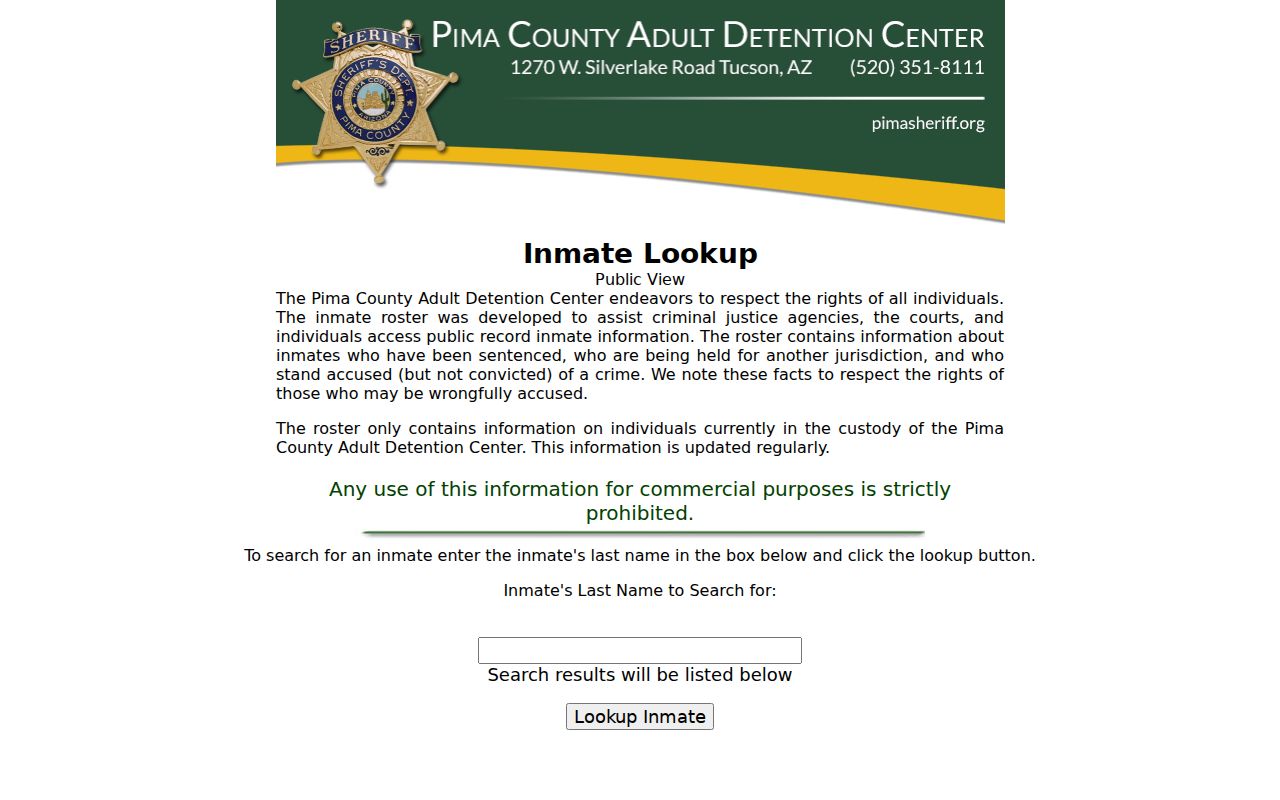
The simple current-custody screen shows why scope matters: it cannot replace a historic court search or establish a person's full record. The Arizona corrections inmate data search separately covers current and former state prisoners, with projected dates that still require confirmation.
The Arizona DPS public offender search is a separate statutory registry with its own published warnings and geographic search functions.
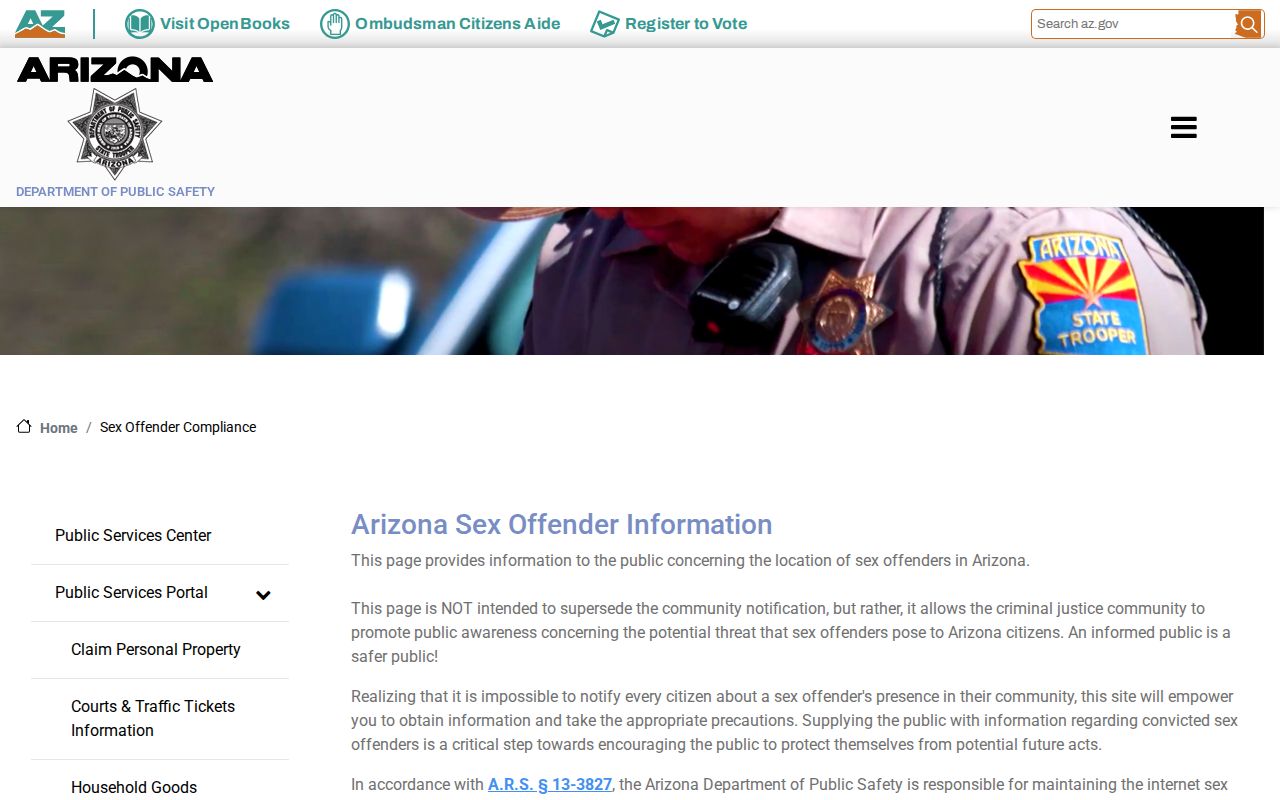
The registry screen must be used only for its stated public-safety purpose. Never use either source to harass, threaten, or spread claims beyond the official result.
Tucson Records Request Fallback
When an index stops, ask the office holding the record. Arizona Public Records Law, A.R.S. Title 39, opens records in an officer's custody to inspection by any person during office hours, subject to lawful exclusions. Arizona has no single universal production deadline. Section 39-171 requires a published contact and, when no centralized portal creates a receipt, an acknowledgement within five business days. Noncommercial inspection is ordinarily free, while authorized copy costs may apply.
Describe the person, record type, date range, case or parcel number, and responsible department as narrowly as possible. Tucson City Clerk routes municipal records. The Pima Clerk handles official court files, and older recorded documents may require Recorder terminals. A focused request avoids sweeping unrelated records and gives staff a clear retrieval path. Commercial requests require purpose disclosure under A.R.S. §39-121.03 and can carry different fees.
Tucson Resident Lookup Limits
Privacy limits vary by source. Arizona’s Address Confidentiality Program gives qualifying survivors of domestic violence, sexual offenses, and stalking a substitute address and mail forwarding. Agencies must follow program rules rather than disclose the actual location. Vital certificates remain restricted until archival transfer. Voter data has purpose controls. Federal motor-vehicle privacy law closes personal DMV information. Courts seal or omit protected categories, and recorded instruments follow formal correction or redaction rules instead of casual deletion.
Correct an error at its source. The Assessor has ownership and mailing correction routes. The Recorder preserves filed instruments and may require a corrective instrument. Court corrections follow court procedure, voter changes go through the Pima Recorder, and license boards control their own records. Fixing a commercial broker listing does not alter the official source from which it may have drawn.
Lawful use. A Tucson resident lookup is for lawful personal research. Never use public information to stalk, harass, threaten, intimidate, or defeat a protected person's confidentiality.
Public access is not permission to amplify harm. Stop when an official rule closes the trail. A careful Tucson resident lookup verifies identity while honoring the boundary each custodian sets.